AI detection was speculated to simplify educational integrity.
As an alternative, it launched a brand new downside: false positives.
Academics are more and more pressured to depend on AI detectors when evaluating scholar work. However as I’ve written earlier than, these instruments are removed from dependable sufficient to behave as judges—particularly when false positives can result in critical educational penalties.
That doesn’t imply detectors don’t have any place in training. It means their function must be reframed.
For academics, the reasonable objective isn’t good detection. It’s screening: figuring out writing that clearly resembles AI output, flagging it for nearer evaluate, after which counting on human judgment to make the ultimate name.
This listing is accuracy-first and deliberately slim. Each detector right here has been examined in prior articles, and solely true-positive efficiency is taken into account. No hype, no theoretical claims — simply what truly labored.
How this listing must be used
Earlier than diving into instruments, it’s value stating this clearly:
No AI detector ought to ever be used as sole proof of misconduct.
Detectors are finest used to reply one query: “Is that this writing sufficiently AI-like that it deserves a better look?”
That nearer look ought to contain:
- evaluating in opposition to the scholar’s prior work
- checking drafting historical past
- asking follow-up questions
- or utilizing in-class writing samples as reference factors
With that framing in place, accuracy nonetheless issues — particularly when time is proscribed.
Sapling (Prime Suggestion)
Sapling is essentially the most constant detector I’ve examined for figuring out plain, unedited AI writing.
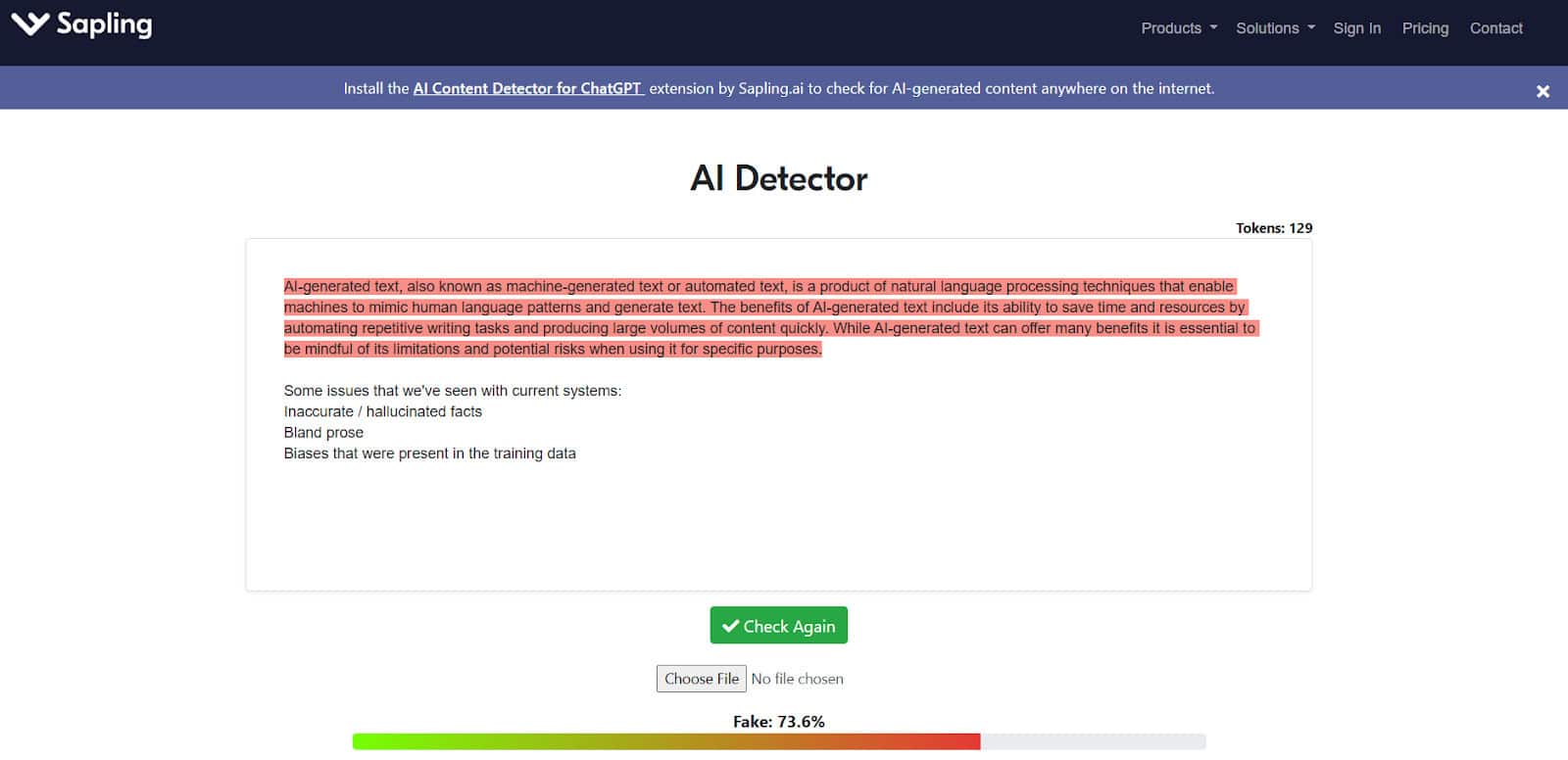
In managed testing, Sapling accurately recognized 100% of baseline ChatGPT outputs, with an general true-positive accuracy rating of 67.92% throughout broader samples that features Undetectable AI output (an AI humanizer).
What makes Sapling particularly appropriate for lecture rooms is restraint. It doesn’t try to over-explain outcomes or inflate confidence. You get a transparent sign, not a theatrical verdict.
That issues. Academics don’t want dramatic percentages — they want predictability. Sapling’s habits is constant sufficient that, when it flags one thing strongly, it’s often value a re-examination.
Sapling can also be largely free, which removes a significant barrier for institutional or private use.
Should you solely use one detector, that is the most secure default.
Winston AI
Winston AI is a extra feature-heavy detector, and its accuracy displays that ambition.
In testing, Winston efficiently detected 100% of simple AI-generated textual content, performing very properly on unmodified LLM outputs, however solely 50% for Undetectable AI outputs.
The place Winston turns into much less predictable is with blended or frivolously edited content material — not as a result of it fails totally, however as a result of its confidence can fluctuate considerably relying on construction and size.
For academics, Winston works finest as a secondary validator, particularly when documentation or reporting is required. It’s not free (which is why this isn’t as sturdy as a advice as Sapling) but it surely’s strong, and its detection power on apparent AI content material is powerful.
Copyleaks
Copyleaks is usually positioned as an institutional software, and its testing outcomes justify that popularity — with caveats.
In prior testing, Copyleaks achieved a 78.27% true-positive accuracy rating.
Its power lies in consistency throughout environments, particularly when paired with plagiarism detection. Nevertheless, its interface and licensing mannequin make it higher fitted to school-wide adoption quite than particular person instructor use.
Copyleaks just isn’t absolutely free, however many establishments have already got entry. That is nice if solely you both have further money to spend or your faculty can provide you one.
TruthScan
In focused testing centered on Gemini outputs, TruthScan achieved a 93% true-positive accuracy rating, outperforming many general-purpose detectors in that state of affairs.
For lecture rooms encountering newer LLM writing types that don’t essentially resemble basic ChatGPT output, TruthScan generally is a helpful addition. That is very true since TruthScan is totally free and likewise works with AI picture detection — making it a really nice platform general.
Different Detectors to Contemplate
Along with the instruments coated above, I additionally examined a broader set of detectors up to now. That article examined over a dozen detectors throughout a variety of fashions and writing sorts, and whereas not all of them make the principle suggestions right here, just a few are nonetheless value figuring out about:
Listed here are different detectors that earned honorable mentions or that you simply may think about for supplementary checks:
- GPTZero — 65.25% true-positive accuracy within the remaining tally. It’s not a prime performer in that dataset, but it surely’s nonetheless a extensively used classroom cross-check—finest handled as a secondary sign, not a deciding issue.
- Originality.ai — 68.83% true-positive accuracy within the remaining tally. Helpful if you’d like a stricter detector with a publishing-style workflow, however its core detection efficiency lands mid-pack right here.
- Content material at Scale (now, BrandWell) — 70.83% true-positive accuracy within the remaining tally. It carried out higher than the weakest instruments, however nonetheless doesn’t beat the highest classroom-safe defaults.
My Ultimate Ideas
If accuracy and accessibility are your main issues, Sapling stays the most effective all-around alternative. It’s free, constant, and strict sufficient to catch apparent AI writing with out encouraging overconfidence.
For higher-stakes conditions, pairing Sapling with GPTZero or Winston AI supplies a extra defensible, multi-signal strategy.
And no matter software, keep in mind this:
AI detectors ought to information consideration, not decide guilt. Used fastidiously, they might help academics navigate a troublesome transition. Used carelessly, they threat undermining belief — precisely the result they had been meant to forestall.