In late August 2017, key figures at OpenAI (then a small nonprofit analysis lab) gathered to debate how they’d create a for-profit to commercialize its expertise and lift the funds wanted to comprehend AGI.
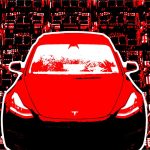
Elon Musk was demanding full management of the corporate and had simply given every of his co-founders a Tesla Mannequin 3. CTO Greg Brockman mentioned he noticed that as approach of buttering them up at a time when Musk and Sam Altman had been vying to win help for his or her respective visions of the corporate’s future. OpenAI’s head of analysis, Ilya Sutskever, had commissioned a portray of a Tesla to provide Musk throughout the assembly as a pleasant gesture.
The dialog didn’t observe that temper: When Musk was instructed the others wouldn’t accede to his demand for management of the corporate, Brockman mentioned he obtained offended and upset. He sat for a number of minutes considering quietly.
Then, in Brockman’s telling, Musk mentioned, “I decline.” The SpaceX and Tesla founder “stood up and stormed across the desk…I assumed he was going to hit me. He grabbed the portray and began to storm out of the room. After which he circled and mentioned, ‘When will you be departing OpenAI?’”
Brockman and Sutskever didn’t go away or decide to Musk’s imaginative and prescient. Musk stopped his common donations to the corporate’s working funds, and inside six months, he would depart the board, although he paid for workplace house the corporate shared with Neuralink till 2020.
As right now’s authorized battle over the way forward for OpenAI proceeds, scrutiny has settled on a key interval in 2017 when the group’s unique co-founders disagreed about who would management its future, ultimately bringing us Musk’s lawsuit in opposition to his co-founders.
We’ve but to listen to from Sam Altman, however OpenAI president Greg Brockman testified for 2 days, usually referencing a private journal that gives a uncommon perception into what it’s wish to be a 30-year-old tech govt in a pitched battle with Elon Musk.
Techcrunch occasion
San Francisco, CA
|
October 13-15, 2026
“It’s very painful,” Brockman mentioned of the publicity across the journal, which he referred to as “deeply private writings that had been by no means meant for the world to see. [But] there’s nothing in there I’m ashamed of.”
Cutthroat negotiations between startup founders are not often shared so publicly, particularly when an organization turns into as world-changing as OpenAI.
We noticed a current style of this rancor when OpenAI’s attorneys shared a textual content message Musk despatched to Brockman two days earlier than the trial started: “By the tip of this week, you and Sam would be the most hated males in America. In the event you insist, so it will likely be.”
The jury gained’t see that observe, however Musk’s attorneys have finished their finest to comprehend its spirit. They’re making an attempt to indicate the courtroom that Altman and Brockman “stole a charity,” whereas OpenAI’s authorized crew tries to indicate that Musk had the very same plan in thoughts.
The inciting incident for all of this was when an OpenAI mannequin defeated the highest human participant within the online game DOTA II. Brockman mentioned that satisfied everybody within the group that compute was the important thing useful resource to create highly effective AI instruments, however that fundraising purely as a nonprofit could be inadequate.
That led to talks a few for-profit subsidiary, of which Musk wished “unequivocal” management, at the very least at first. The opposite founders proposed equal shares, and maybe extra fairness commensurate with a money funding. One other thought on the desk was someway connecting OpenAI to Tesla’s AI work. Shivon Zilis, an OpenAI advisor who acted as a go-between for Musk and the crew there, mentioned there have been greater than 20 variations on the plan.
However when the opposite founders wouldn’t give Musk management, their partnership unraveled.
“It shouldn’t be the case that there exists one individual with full and absolute management over OpenAI,” Brockman testified. Brockman and Sutskever mentioned a plan to kick Elon off OpenAI’s board to be able to transfer ahead, leading to November 2017 journal entries that Musk’s attorneys have targeted on.
‘[C]an’t see us turning this right into a for-profit and not using a very nasty struggle,” Brockman wrote. “[I’m] simply occupied with the workplace and we’re within the workplace. and his story will accurately be that we weren’t sincere with him ultimately about nonetheless desirous to do the for revenue simply with out him….btw one other realization from that is that it’d be flawed to steal the non-profit from him. to transform to a b-corp with out him. that’d be fairly morally bankrupt. and he’s actually not an fool.”
That “steal the non-profit” line could seem damning, however the context, in keeping with Brockman, was whether or not or to not attempt to toss Musk off the board. They finally didn’t do this. Musk left the board voluntarily in February 2018, concluding that “OpenAI is on a path of sure failure,” saying he deliberate to focus extra on AI at Tesla.
Brockman described his reflections as an effort to find out whether or not he could be happy together with his work life.
“That is the one probability we’ve got to get out from Elon,” he wrote throughout the talks. “Is he the ‘superb chief’ that I might choose? We actually have an opportunity to make this occur. Financially what is going to take me to $1B?”
That final reflection was additionally seized on by Musk’s attorneys as an indication that Brockman was considering extra about his private wealth than the nonprofit’s mission. Brockman mentioned his present stake within the firm is price nearly $30 billion, which turned a chance for Steve Molo, the principle trial legal professional for Musk, to berate him.
“Why you didn’t take the $29 billion greater than the billion you mentioned you’ll be good with, and donate that to the charity?” Molo demanded.
“Take a look at what we achieved,” Brockman replied. “The OpenAI nonprofit has over $150 billion of OpenAI fairness worth. That’s one thing we’ve got constructed by arduous work, blood, sweat, and tears, all this time since Elon has left.”
Molo additionally dwelt on emails from the place Brockman mentioned he’ll donate $100,000 to OpenAI, one thing he by no means did. Paradoxically, Brockman is likely to be finest identified to the general public for making the biggest donation of the 2025 political cycle, $25 million given to MAGA Inc., a SuperPAC supporting President Donald Trump, however that didn’t come up within the trial.
Molo did mock Brockman’s description of the charged assembly round his management of the corporate as Musk being “imply” to Brockman, and instructed that Brockman didn’t perceive the governance points the way in which Musk, a serial founder, did.
Brockman, although, mentioned Musk didn’t perceive AI. “He didn’t and doesn’t know AI,” he testified, describing Musk dismissing an early demonstration of the software program that may grow to be ChatGPT. “We didn’t assume he was going to spend the time required to really get good at it.”
“The truth that Elon noticed this very early model of the analysis, that basically set all this stuff in movement, [and] didn’t acknowledge that spark — that was precisely the type of factor that was vital to keep away from taking place on this atmosphere,” Brockman mentioned.
In 2019, OpenAI would create a for-profit and use it to boost $1 billion from Microsoft. The corporate would elevate an extra $13 billion from the software program large over the following 4 years, fueling its rise because the main AI frontier lab. It additionally fueled the web price of the corporate’s executives and staff, in addition to the property held by OpenAI the nonprofit.
And finally, these offers fueled Musk’s suspicions that Altman and Brockman obtained one over on him, main him to file his go well with in 2024. The trial is anticipated to proceed by subsequent week.
Once you buy by hyperlinks in our articles, we could earn a small fee. This doesn’t have an effect on our editorial independence.