Please note: Most, if not all, of the articles published at this website were completed by Chat GPT (chat.openai.com) and/or copied and possibly remixed from other websites or Feedzy or WPeMatico or RSS Aggregrator or WP RSS Aggregrator. No copyright infringement is intended. If there are any copyright issues, please contact: bicycledays@yahoo.com.
OpenAI has launched two open-source language fashions, GPT-Oss-120b and GPT-Oss-20b. These are OpenAI’s first brazenly licensed LLMs since GPT-2. Aiming to create the very best state-of-the-art reasoning and tool-use fashions accessible. The fashions had been launched to appreciable fanfare within the AI group.
By open-sourcing GPT-Oss, OpenAI permits individuals to freely use and adapt throughout the bounds of Apache 2.0. These two fashions actually contemplate a democratic strategy for skilled personalization and customization of the expertise to native, contextual duties. On this article information, we’ll undergo find out how to entry GPT-Oss-120b and GPT-Oss-20b, and when to make use of which mannequin.
What Makes GPT-Oss Particular?
OpenAI’s new open-weight fashions are probably the most strong public fashions since GPT-2. It makes use of the newest approaches from probably the most superior programs and is constructed to actually work and be straightforward to make use of and adapt.
Open Apache 2.0 License: The GPT-Oss fashions are each fully open-weight fashions and are licensed underneath the permissive Apache 2.0 license. This implies there are not any copyleft restrictions and builders can use them for analysis or business merchandise with no licensing charges or source-code obligations.
Configurable Reasoning Ranges: A singular function is the benefit of configuring the mannequin’s reasoning effort: low, medium, or excessive. It is a trade-off of pace vs. depth. A easy system message like “Use low reasoning” or “Use excessive reasoning” will make the mannequin assume much less or extra deeply earlier than it solutions.
Full Chain-of-Thought Entry: In contrast to many closed fashions, GPT-Oss reveals its inside reasoning. It has a default output of an evaluation, i.e, reasoning steps channel, adopted by a last reply channel. Customers and builders can examine or filter the portion to debug or belief the mannequin’s reasoning.
Native Agentic Capabilities: These fashions are constructed on an agentic workflow. They’re constructed in direction of instruction-following, and they’re constructed with native help for utilizing instruments of their pondering.
Mannequin Overview & Structure
Each GPT-Oss fashions are Transformer-based networks using a Combination-of-Consultants (MoE) design. In an MoE, solely a subset of the complete parameters (“consultants”) is lively for every enter token, lowering computation. By way of numbers:
GPT-Oss-120b has 117 billion whole parameters (36 layers). It makes use of 128 knowledgeable sub-networks, with 4 consultants lively per token. This leads to solely ~5.1 billion lively parameters per token.
GPT-Oss-20b has 21 billion whole parameters (24 layers) with 32 consultants (4 lively), yielding ~3.6 billion lively parameters per token.
The structure additionally consists of a number of superior options: all consideration layers use Rotary Positional Embeddings (RoPE) to deal with very lengthy contexts (as much as 128,000 tokens). Consideration itself alternates between a full-global and a 128-token sliding window, just like GPT-3’s design.
These fashions use grouped multi-query consideration with a gaggle measurement of 8 to save lots of reminiscence whereas sustaining quick inference. Activations are SwiGLU. Importantly, all knowledgeable weights are quantized to a 4-bit MXFP4 format, permitting the big mannequin to slot in one 80GB GPU and the smaller mannequin in 16GB with out a main accuracy loss.
The desk beneath summarizes the core specs:
Mannequin
Layers
Complete Params
Energetic Params/Token
Consultants (whole/lively)
Context
GPT-Oss-120b
36
117B
5.1B
128 / 4
128K
GPT-Oss-20b
24
21B
3.6B
32 / 4
128K
Technical Specs & Licensing
{Hardware} Necessities: GPT-Oss-120b wants a high-end GPU (~80–100 GB VRAM) and runs on a single 80 GB A100/H100-class GPU or multi-GPU setups. GPT-Oss-20b is lighter, operating in ~16 GB VRAM even on laptops or Apple Silicon. Each fashions help 128K token contexts, very best for lengthy paperwork however compute-intensive.
Quantization & Efficiency: Each fashions use 4-bit MXFP4 because the default, which helps in lowering reminiscence use and rushing up inference. Nevertheless, with out suitable {hardware}, they fall again to 16-bit and require roughly ~48 GB for GPT-Oss-20b. Velocity might be additional improved utilizing non-compulsory superior kernels like FlashAttention.
License & Utilization: Launched underneath Apache 2.0, each fashions can be utilized, modified, and distributed freely, even for business use, with no royalties or code-sharing necessities. No API charges or license restrictions apply.
Specification
GPT-Oss-120b
GPT-Oss-20b
Complete Parameters
117 billion
21 billion
Energetic Parameters per Token
5.1 billion
3.6 billion
Structure
Combination-of-Consultants with 128 consultants (4 lively/token)
Combination-of-Consultants with 32 consultants (4 lively/token)
Transformer Blocks
36 layers
24 layers
Context Window
128,000 tokens
128,000 tokens
Reminiscence Necessities
80 GB (matches on a single H100 GPU)
16 GB
Set up and Setup Course of
Listed here are the methods to get began with GPT-Oss:
1. Hugging Face Transformers: Set up the newest libraries and cargo the mannequin straight. The next command installs the mandatory conditions:
pip set up --upgrade speed up transformers
The code beneath downloads the required mannequin from the Hugging Face hub.
As soon as the mannequin has been downloaded, you’ll be able to check it out utilizing:
messages = [

   {"role": "system", "content": "You are a helpful assistant."},

   {"role": "user", "content": "Explain why the sky is blue."}

]

inputs = tokenizer.apply_chat_template(

   messages, add_generation_prompt=True, return_tensors="pt"

).to(mannequin.machine)

outputs = mannequin.generate(**inputs, max_new_tokens=200)

print(tokenizer.decode(outputs[0]))
This setup was documented in OpenAI’s information and runs on any GPU. (For greatest pace on NVIDIA A100/H100 playing cards, set up triton kernels to make use of MXFP4; in any other case the mannequin will use 16-bit internally).
2. vLLM: For prime-throughput or multi-GPU serving, you should utilize the vLLM library. OpenAI notes that on 2x H100s. You may set up vLLM utilizing:
from vllm import LLM

llm = LLM("openai/gpt-oss-120b", tensor_parallel_size=2)

output = llm.generate("San Francisco is a")

print(output)
This makes use of optimized consideration kernels on Hopper GPUs.
3. Ollama (Native on Mac/Home windows): Ollama is a turnkey native chat server. After putting in Ollama, merely run:
ollama pull gpt-oss:20b
ollama run gpt-oss:20b
This can obtain the mannequin (quantized) and launch a chat UI. Ollama auto-applies a chat template (the “concord” format) by default. You may also name it through API. For instance, utilizing Python and the OpenAI SDK pointed at Ollama’s endpoint:
from openai import OpenAI

shopper = OpenAI(base_url="http://localhost:11434/v1", api_key="ollama")

response = shopper.chat.completions.create(

   mannequin="gpt-oss:20b",

   messages=[

       {"role": "system", "content": "You are a helpful assistant."},

       {"role": "user", "content": "Explain what MXFP4 quantization is."}

   ]

)

print(response.decisions[0].message.content material)
This sends the immediate to the native GPT-Oss mannequin, identical to the official API.
4. Llama.cpp (CPU/ARM): Pre-built GGUF variations of the fashions can be found (e.g, ggml-org/GPT-Oss-120b-GGUF on Hugging Face). After putting in llama.cpp, you’ll be able to serve the mannequin regionally:
# macOS:

brew set up llama.cpp

# Begin a neighborhood HTTP server for inference:

llama-server -hf ggml-org/gpt-oss-120b-GGUF -c 0 -fa --jinja --reasoning-format none
Then ship chat messages to http://localhost:8080 in the identical format. This feature permits operating even on a CPU or GPU-agnostic setting with JIT or Vulkan help.
Total, GPT-Oss fashions can be utilized with commonest frameworks. The above strategies (Transformers, vLLM, Ollama, llama.cpp) cowl desktop and server setups. You may combine and match – as an illustration, run one setup for quick inference (vLLM on GPU) and one other for on-device testing (Ollama or llama.cpp).
Palms-On Demo Part
Process 1: Reasoning Process
Immediate:“”” Choose the choice that’s associated to the third time period in the identical means because the second time period is said to the primary time period.
IVORY : ZWSPJ :: CREAM : ?
A. NFDQB
B. SNFDB
C. DSFCN
D. BQDZL
”””
import os

os.environ['HF_TOKEN'] = 'HF_TOKEN'

from openai import OpenAI

shopper = OpenAI(

   base_url="https://router.huggingface.co/v1",

   api_key=os.environ["HF_TOKEN"],

)

completion = shopper.chat.completions.create(

   mannequin="openai/GPT-Oss-20b", # openai/GPT-Oss-120b Change to make use of 120b mannequin

   messages=[

       {

           "role": "user",

           "content": """Select the option that is related to the third term in the same way as the second term is related to the first term.

             IVORY : ZWSPJ :: CREAM : ?

A. NFDQB

B. SNFDB

C. DSFCN

D. BQDZL

"""

       }

   ],

)

# Verify if there's content material in the principle content material area

if completion.decisions[0].message.content material:

   print("Content material:", completion.decisions[0].message.content material)

else:

   # If content material is None, test reasoning_content

   print("Reasoning Content material:", completion.decisions[0].message.reasoning_content)

# For Markdown show in Jupyter

from IPython.show import show, Markdown

# Show the precise content material that exists

content_to_display = (completion.decisions[0].message.content material or

                    completion.decisions[0].message.reasoning_content or

                    "No content material accessible")
GPT-Oss-120b Response:
To the purpose response
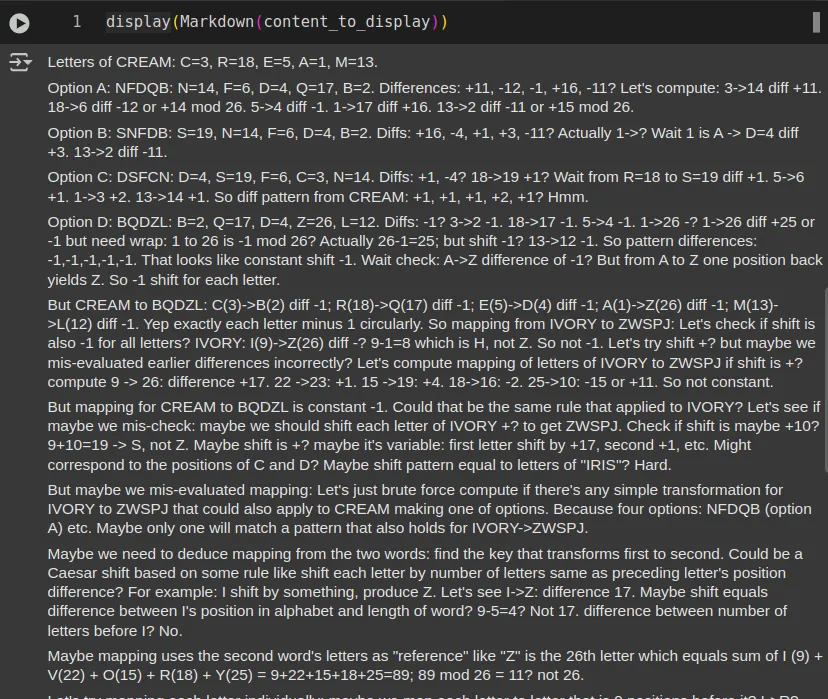
GPT-Oss-20b Response:
Elaborate response
Comparative Evaluation
GPT-Oss-120B appropriately identifies the related sample within the analogy and selects possibility C with deliberate reasoning. Because it methodically interprets the character transformation between phrase pairs to acquire the proper mapping. However, GPT-Oss-20B fails to yield any end result on this activity, possible as a result of limits of the output tokens.
This would possibly counsel difficulties with output size, in addition to computational inefficiencies. Total, GPT-Oss-120B is healthier capable of handle symbolic reasoning with far more management and accuracy; subsequently, it’s extra dependable than GPT-Oss-20B for this reasoning activity involving verbal analogy.
Process 2: Code Technology
Immediate: “”” Given two sorted arrays nums1 and nums2 of measurement m and n respectively, return the median of the 2 sorted arrays.
The general run time complexity ought to be O(log (m+n)) in C++.
Instance 1:
Enter: nums1 = [1,3], nums2 = [2]
Output: 2.00000
Rationalization: merged array = [1,2,3] and median is 2.
Instance 2:
Enter: nums1 = [1,2], nums2 = [3,4]
Output: 2.50000
Rationalization: merged array = [1,2,3,4] and median is (2 + 3) / 2 = 2.5.
Constraints:
nums1.size == m
nums2.size == n
0 <= m <= 1000
0 <= n <= 1000
1 <= m + n <= 2000
-106 <= nums1[i], nums2[i] <= 106
”””
import os

from openai import OpenAI

shopper = OpenAI(

   base_url="https://router.huggingface.co/v1",

   api_key=os.environ["HF_TOKEN"],

)

completion = shopper.chat.completions.create(

   mannequin="openai/GPT-Oss-120b", # openai/GPT-Oss-20b change to make use of 20b mannequin

   messages=[

       {

           "role": "user",

           "content": """Given two sorted arrays nums1 and nums2 of size m and n respectively, return the median of the two sorted arrays.

             The overall run time complexity should be O(log (m+n)) in C++.

             Example 1:

             Input: nums1 = [1,3], nums2 = [2]

             Output: 2.00000

             Rationalization: merged array = [1,2,3] and median is 2.

             Instance 2:

             Enter: nums1 = [1,2], nums2 = [3,4]

             Output: 2.50000

             Rationalization: merged array = [1,2,3,4] and median is (2 + 3) / 2 = 2.5.

             Constraints:

             nums1.size == m

             nums2.size == n

             0 <= m <= 1000

             0 <= n <= 1000

             1 <= m + n <= 2000

             -106 <= nums1[i], nums2[i] <= 106

"""

       }

   ],

)

# Verify if there's content material in the principle content material area

if completion.decisions[0].message.content material:

   print("Content material:", completion.decisions[0].message.content material)

else:

   # If content material is None, test reasoning_content

   print("Reasoning Content material:", completion.decisions[0].message.reasoning_content)

# For Markdown show in Jupyter

from IPython.show import show, Markdown

# Show the precise content material that exists

content_to_display = (completion.decisions[0].message.content material or

                    completion.decisions[0].message.reasoning_content or

                    "No content material accessible")
GPT-Oss-120b Response
embrace <bits/stdc++.h>

utilizing namespace std;

class Answer {

public:

   double findMedianSortedArrays(const vector<int>& nums1,

                                  const vector<int>& nums2) {

       // Let A be the shorter array.

       const vector<int>* A = &nums1;

       const vector<int>* B = &nums2;

       if (A->measurement() > B->measurement()) swap(A, B);   // now |A| ≤ |B|

       int m = A->measurement();

       int n = B->measurement();

       int whole = m + n;

       int half = (whole + 1) / 2;   // measurement of left half

       int low = 0, excessive = m;       // we search over variety of parts taken from A

       whereas (low <= excessive) {

           int i = (low + excessive) / 2;            // parts from A on the left facet

           int j = half - i;                     // should come from B

           // Edge dealing with: use infinities for out‑of‑vary indices

           int a_left  = (i == 0 ? INT_MIN : (*A)[i - 1]);

           int a_right = (i == m ? INT_MAX : (*A)[i]);

           int b_left  = (j == 0 ? INT_MIN : (*B)[j - 1]);

           int b_right = (j == n ? INT_MAX : (*B)[j]);

           if (a_left > b_right) {               // i too massive

               excessive = i - 1;

           } else if (b_left > a_right) {       // i too small

               low = i + 1;

           } else {                             // appropriate break up

               int max_left = max(a_left, b_left);

               if (whole % 2 == 1)          // odd

                   return static_cast<double>(max_left);

               int min_right = min(a_right, b_right);

               return (max_left + min_right) / 2.0;

           }

       }

       // The code by no means reaches right here as a result of the constraints assure not less than one factor.

       return 0.0;

   }

};

/* Instance utilization
int predominant() {

   Answer s;

   vector<int> a = {1, 3};

   vector<int> b = {2};

   cout << fastened << setprecision(5) << s.findMedianSortedArrays(a, b) << endl; // 2.00000

   a = {1,2};

   b = {3,4};

   cout << fastened << setprecision(5) << s.findMedianSortedArrays(a, b) << endl; // 2.50000

}
GPT-Oss-20b Response
# Reference Implementation (C++17)

embrace <bits/stdc++.h>

utilizing namespace std;

class Answer {

public:

   double findMedianSortedArrays(vector<int>& nums1,

                                 vector<int>& nums2) {

       // Guarantee nums1 is the shorter array

       if (nums1.measurement() > nums2.measurement())

           return findMedianSortedArrays(nums2, nums1);

       int m = nums1.measurement();

       int n = nums2.measurement();

       int low = 0, excessive = m;

       int halfLen = (m + n + 1) / 2;          // measurement of left half

       whereas (low <= excessive) {

           int i = (low + excessive) / 2;          // partition in nums1

           int j = halfLen - i;               // partition in nums2

           // i too small - should transfer proper

           if (i < m && nums2[j-1] > nums1[i])

               low = i + 1;

           // i too massive - should transfer left

           else if (i > 0 && nums1[i-1] > nums2[j])

               excessive = i - 1;

           else {

               // appropriate partition discovered

               int maxLeft;

               if (i == 0)

                   maxLeft = nums2[j-1];

               else if (j == 0)

                   maxLeft = nums1[i-1];

               else

                   maxLeft = max(nums1[i-1], nums2[j-1]);

               // odd whole, median is maxLeft

               if ((m + n) % 2 == 1)

                   return static_cast<double>(maxLeft);

               // even whole, want minRight as effectively

               int minRight;

               if (i == m)

                   minRight = nums2[j];

               else if (j == n)

                   minRight = nums1[i];

               else

                   minRight = min(nums1[i], nums2[j]);

               return (maxLeft + minRight) / 2.0;

           }

       }

       // Ought to by no means attain right here for legitimate enter

       return 0.0;

   }

};

/* Instance utilization:

int predominant() {

   Answer s;

   vector<int> a = {1, 3};

   vector<int> b = {2};

   cout << fastened << setprecision(5) << s.findMedianSortedArrays(a, b) << endl; // 2.00000

}
Comparative Evaluation
GPT-Oss-120B completes the analogy precisely, deciding on possibility C, and reveals robust rationale by efficiently figuring out the letter substitution sample. The mannequin reveals good reasoning when it comes to dealing with shifts within the letters’ oscillatory and protecting monitor of relationships between issues. However, GPT-Oss-20B is unable to even full the duty! The mannequin exceeded the output token restrict and didn’t return a solution. This means GPT-Oss-20B is inefficient in both its useful resource utilization or its dealing with of the immediate. Total, GPT-Oss-120B demonstrates a lot better efficiency in structured reasoning duties, making it a a lot better alternative than GPT-Oss-20B for duties associated to symbolic analogies.
Mannequin Choice Information
Selecting between the 120B and 20B fashions is determined by the wants of 1’s challenge or the duty on which we’re working:
gpt-oss-120b: That is the high-power mannequin. Use it for the toughest reasoning duties, complicated code era, math downside fixing, or domain-specific Q&A. It performs near OpenAI’s o4-mini mannequin. Subsequently, it wants a big GPU with roughly 80GB+ VRAM to run it and excels on benchmarks and long-form duties the place step-by-step reasoning is essential.
gpt-oss-20b: It is a “workhorse” mannequin optimized for effectivity. It matches the standard of OpenAI’s o3-mini on many benchmarks, however can run on a single 16GB VRAM. Select 20B whenever you want a quick on-device assistant, low-latency chatbot, or instruments that use internet search/Python calls. It’s very best for proof-of-concepts, cellular/edge functions, or when {hardware} is constrained. In lots of instances, the 20B mannequin solutions effectively sufficient. For instance, it scored ~96% on a troublesome math contest activity, almost matching 120B.
Efficiency Benchmarks and Comparisons
On normal benchmarks, OpenAI’s gpt-oss shares outcomes. The 120B mannequin works its means upward, scoring larger than the 20B mannequin on powerful reasoning and data duties, each nonetheless having glorious performances.
Benchmark
gpt-oss-120b
gpt-oss-20b
OpenAI o3
OpenAI o4-mini
MMLU
90.0
85.3
93.4
93.0
GPQA Diamond
80.1
71.5
83.3
81.4
Humanity’s Final Examination
19.0
17.3
24.9
17.7
AIME 2024
96.6
96.0
95.2
98.7
AIME 2025
97.9
98.7
98.4
99.5
Use Circumstances and Functions
Listed here are some functions for GPT-Oss:
Content material Technology and Rewriting: Generate or rewrite articles, tales, or advertising copy. These fashions can describe their thought course of earlier than writing and help writers and journalists in growing higher content material.
Tutoring and Schooling: can show other ways to explain an idea, stroll by way of issues step-by-step, and supply suggestions to academic apps or tutoring instruments, and drugs.
Code Technology: can generate code, debug code, or clarify code very effectively. Fashions may internally execute instruments, permitting them to be useful with associated growth duties or as coding assistants.
Analysis Help: can summarize paperwork, reply to domain-specific questions, and analyze information. The bigger fashions may also be fine-tuned for particular fields of examine, comparable to legislation, drugs, or science.
Autonomous Brokers: Permits actions that use instruments to construct bots with autonomous brokers that may browse the online, name APIs, or run code. Integrates simply with agent frameworks to construct extra complicated step-based workflows.
Conclusion
The 120B mannequin clearly outperforms throughout the board: producing sharper content material, fixing more durable issues, writing higher code, and adapting quicker in analysis and autonomous duties. Its solely actual tradeoff is useful resource depth, which makes native deployment a problem. However in the event you’ve obtained the infrastructure, there’s no contest. This isn’t simply an improve! It’s a complete new tier of functionality.
Hiya! I am Vipin, a passionate information science and machine studying fanatic with a robust basis in information evaluation, machine studying algorithms, and programming. I’ve hands-on expertise in constructing fashions, managing messy information, and fixing real-world issues. My purpose is to use data-driven insights to create sensible options that drive outcomes. I am desperate to contribute my abilities in a collaborative setting whereas persevering with to study and develop within the fields of Information Science, Machine Studying, and NLP.
Login to proceed studying and revel in expert-curated content material.