Observe ZDNET: Add us as a most well-liked supply on Google.
ZDNET’s key takeaways
- Plug-in photo voltaic makes use of microinverters to feed energy right into a family system.
- Thus far, within the US, solely Utah has handed laws to permit such programs.
- These programs value about $2,400 and can take years to repay.
Ever since dealing with my first tiny photo voltaic panel fairly a couple of many years in the past, I have been fascinated by them. The truth that a little bit of glass had the power to reap energy from an enormous nuclear orb 93 million miles away blew my thoughts again then, and continues to blow my thoughts now. Since then, photo voltaic panels have grown in measurement and effectivity and dropped in value to the purpose the place it is changing into economically possible for you and me to purchase panels and generate our personal electrical energy.
However what do you do with that energy?
Up till now, you’ve got had two choices. You might have a typical rooftop photo voltaic system, have that professionally linked to your house’s electrical system, or you might join your panels to a transportable energy station, and use that to energy units in your house.
The draw back to the primary possibility is value, since putting in photo voltaic panels in your roof and connecting them to your electrical system is knowledgeable job. The draw back to the second possibility is the limitation of getting all the facility circulate by way of an influence station.
However what should you might join your photo voltaic panels on to your house’s AC system, and try this your self?
That is what plug-in photo voltaic — also called balcony photo voltaic or transportable photo voltaic — guarantees.
What plug-in photo voltaic is not, and what it really is
Let me dispel the largest fable proper off the bat — plug-in photo voltaic is not an AC plug hooked up to your photo voltaic panels. Family energy is AC, whereas photo voltaic panels output DC (direct present), so the 2 aren’t appropriate. Should you tried to plug panels instantly right into a wall socket, lots of issues would go bang.
Plug-in photo voltaic is a brand new expertise that permits photo voltaic panels to be linked to a house’s electrical system. The thought is that the photo voltaic panels accumulate energy in the course of the day, feed it into the house’s system, and that energy is used to cowl the house’s daytime base load, and maybe a bit extra (extra on base load in a second).
What sits between the photo voltaic panels and your outlet is a microinverter. It is a field that converts DC electrical energy from photo voltaic panels into AC that your house home equipment perceive. It could possibly then feed this AC energy into your house’s electrical system through a typical plug and outlet (so your outlet turns into an inlet).
In addition to changing DC energy to AC, the microinverter has to not solely inject that energy into your house’s energy system, however achieve this safely.
It is that straightforward. You need not rent knowledgeable; you are able to do it your self. It additionally opens up photo voltaic to these dwelling in rented properties or in residences. In Utah, for instance, landlords can not object to tenants putting in plug-in photo voltaic programs that plug into an outlet and don’t require any everlasting modifications to the property.
What’s base load?
Base load is the background load {that a} home attracts in the course of the day when no main home equipment are actively in use. It represents the continual power draw from important and standby units, reminiscent of web and Wi-Fi routers, chargers, fridges, and freezers. As a ballpark determine, that is roughly 200 to 400 watts (or 4.8 to 9.6 kWh over 24 hours) for the typical US house.
How a lot energy you may pull depends upon elements like the dimensions of your photo voltaic panel setup in watts and the way a lot solar you get in your space (referred to as Peak Solar Hours, or PSH), and never forgetting to take away the losses by way of inefficiencies, shading, and dirt and filth on the panels (referred to as derate).
The derate determine can fluctuate, however I’ve gone for 0.77 (equal to a 23% loss), which errs on the facet of pessimism.
Power Collected (kWh/day) = Panel Output (kW) × Peak Solar Hours (PSH) × Derate Issue (0.77)
Should you stay in Alabama and get a mean of three.5 hours of solar a day, a 1 kW (1,000-watt) photo voltaic panel array will accumulate:
1 x 3.5 x 0.77 = 2.7 kWh
Change to someplace like Arizona, with about 6.5 hours of solar, and the determine climbs loads.
1 x 6.5 x 0.77 = 5 kWh
How does it work?
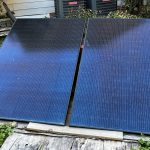
You place your photo voltaic panels within the backyard or on a balcony (balcony set up is nice for folks renting or dwelling in residences), join them to the microinverter, plug them into an outlet, and that is it, you are harvesting solar energy whereas the solar is shining. So long as you are accumulating 200 to 400 watts, you’ve got lined base load.
OK, however what concerning the surplus?
Properly, you have got choices. The surplus can go into the grid (you are not prone to be paid for this, at the very least below present home electrical tariffs, however that might change), or you may push the excess into an influence station to be used later. Including an influence station into the combination goes to spice up prices.
So, what’s stopping us from utilizing plug-in photo voltaic?
Backside line: It is primarily authorities purple tape.
Whereas plug-in photo voltaic is offered in some international locations, like Spain and Germany, the place you may stroll right into a superstore and purchase a plug-in photo voltaic setup, the US and UK are lagging behind. (Right here within the UK, Anker has simply unveiled the SolarBank 4 E5000 Professional — what a mouthful! — forward of the modifications within the rules to permit these programs.)
Based mostly on the info obtainable, plainly Utah is the one US state to date that has legalized using plug-in photo voltaic items, with 29 different states pushing laws to make them authorized. Utah permits programs as much as 1.2 kW with out utility approval or charges. As for laws at present within the pipeline, most states appear to be sticking with that 1.2 kW restrict.
One exception is Colorado, which needs to push that restrict as much as 1.92 kW. Evaluate this to the UK and Europe, which restrict the facility to 800W.
Prices and advantages
Price can be undoubtedly holding again plug-in photo voltaic, as these programs aren’t low-cost, particularly in comparison with the price of electrical energy (which, on common, is about 17 cents per kWh).
A 1,200 W plug-in photo voltaic equipment will at present set you again about $2,400. I anticipate that as extra states give plug-in photo voltaic the thumbs-up and extra gamers enter the market, costs will come down.
Should you stay in Utah and you have dropped $2,400 on a system, how a lot will this prevent? The very best-case PSH for Utah is 7 hours, and plugging this into the equation above provides:
1.2 x 7 x 0.77 = 6.5 kWh
That is lots of energy, value some $0.86 a day (Utah electrical energy value $0.1333 per kWh in February, primarily based on authorities information), or some $315 a yr. Assuming the whole lot goes easily, you will recoup your preliminary funding in 7.5 years.
Should you’re simply utilizing the plug-in photo voltaic system to cowl base load throughout daytime hours, this determine turns into fairly dismal. Assuming your base load is a hefty 400 W, your plug-in photo voltaic will cowl 2.8 kWh throughout daytime, however it’s solely value about $0.37 a day, or $135 a yr.
Which means it is 17 years earlier than you’ve got paid for the system.
You both should be working much more in the course of the day than base load — reminiscent of working heavy home equipment like AC or heating, or charging EVs — or pushing the additional energy into an influence station (which, as I’ve already talked about, considerably will increase the prices of your setup).
Is plug-in photo voltaic protected?
One concern raised by legislators in some states is that plug-in photo voltaic installations will not be protected. Something could be unsafe (lithium batteries at the moment are a significant reason behind home fires), so there is a threat that plug-in photo voltaic might be abused or broken to the purpose of changing into unsafe. All plug-in photo voltaic programs have to adapt to Nationwide Electrical Code (NEC) rules and require Underwriters Laboratories (UL) certification.
That is about as protected as the rest we use.
I’ve had an EcoFlow PowerStream microinverter for over six months, working on an remoted take a look at grid (plug-in photo voltaic is not but authorized right here within the UK both, so I have been restricted to check programs), and I’ve had no points with the {hardware}.
Do you want plug-in photo voltaic?
Proper now, plug-in photo voltaic is a distinct segment product, which implies costs are excessive and it’ll take a very long time to pay for itself. However as extra international locations and states confide in plug-in photo voltaic, I anticipate competitors to extend and costs to fall.
My recommendation proper now could be that should you stay someplace sunny and use lots of energy in the course of the day — possibly you cost an EV or have a Tower of Energy, as I do — you may cowl your prices in a couple of years. However should you stay in Alaska, the place you get a few hours of solar a day, and all of your system goes to energy is an web router, it is not value it. Not less than for now.
However watch this area, as a result of that is going to evolve loads over the approaching months and years, and costs might change dramatically.