Observe ZDNET: Add us as a most well-liked supply on Google.
With the rise of each day temperatures, energy payments are inclined to comply with. I have been experimenting with offsetting my very own energy invoice with photo voltaic, and located a sustainable resolution. The Anker Solix F3800 Plus is an expandable battery with a 3.84kWh capability, working like a cross between a conventional fuel generator, a everlasting house battery backup system, and a conveyable battery.
Do not let its wheels idiot you, although. The F3800 Plus is not designed for tent tenting (although you technically may when you can simply lug round all 136 kilos). It is a moveable battery became a legit whole-home backup system, able to operating fridges, moveable ACs, pumps, energy instruments, and even some central AC methods.
Finest photo voltaic offers of the week
Offers are chosen by the CNET Group commerce workforce, and could also be unrelated to this text.
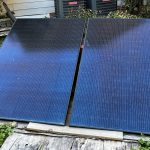
I arrange the Anker Solix F3800 Plus with two photo voltaic panels, which you should buy as a set from Anker. I’ve had success testing EcoFlow and Anker Solix moveable photo voltaic panels in my yard, so I used to be trying ahead to giving these two 410W inflexible panels a strive.
Collectively, the panels add as much as 820W, although photo voltaic panels hardly ever hit their rated output. Fortunately, there are a number of methods to arrange the F3800 Plus as a house backup system, starting from easy to superior.
Easy methods to arrange yard photo voltaic panels
The best manner to make use of the Anker Solix F3800 Plus as a backup system is to instantly plug home equipment into it. For those who set it up in a everlasting spot and need it to energy your fridge, you possibly can join the photo voltaic panels to the facility station, run an extension twine to the fridge, and plug it in completely.
Relying on the realm, powering a full-size side-by-side fridge that makes use of 25-67kWh month-to-month with photo voltaic power can prevent as much as $20 a month on utility prices. That interprets to $240 only for the fridge.
Probably the most sensible resolution to a yard photo voltaic panel system with an F3800 Plus is to make use of a generator inlet and switch change, particularly in houses the place this already exists. This candy spot was the answer in my house, particularly with an present (albeit nonworking) generator and an EcoFlow Good Dwelling Panel 3.
For those who join your F3800 Plus to a generator inlet and have a switch change with a choose variety of house circuits, you possibly can flip the change if the facility goes out. This lets the F3800 Plus act as a backup generator, nevertheless it’s cleaner and safer than a conventional fuel generator, eliminating fumes and warmth era.
The third and most superior choice for utilizing the Anker Solix F3800 Plus together with your photo voltaic panels is to attach it to a sensible house panel or a whole-home backup system. Anker gives its personal Good Dwelling Energy Panel that robotically detects outages and switches to the battery backup with out your intervention, and in addition manages photo voltaic charging.
This ultimate choice is extra expensive and requires skilled set up. Nonetheless, it really works very similar to the Tesla Powerwall, the EcoFlow Good Dwelling Panel, or the Generac PWRcell — that are all common whole-home battery backup methods.
What this setup generates for me
With two 410W photo voltaic panels totaling 820W and an F3800 Plus, you possibly can create a steady “important hundreds” photo voltaic power setup. With first rate solar publicity on clear days and with the right panel placement, I can get a mean of three.7kWh per day from my photo voltaic panels, however that might go as much as about 5kWh each day with higher placement.
My husband purchased brackets, casters, and wooden to construct a base for the photo voltaic panels that may make them extra environment friendly and moveable than their present setup, however that is nonetheless on his to-do record. As you possibly can see within the pictures, the panels are presently sitting on a makeshift base comprised of leftover reclaimed wooden items we had within the storage. Finally, a base that we will transfer round will assist us get much more photo voltaic power.
Photo voltaic offset vs steady load
For those who hold your common each day power consumption beneath your common photo voltaic era, you’ll utterly dwell off of photo voltaic power. That, nevertheless, is tough with a yard photo voltaic system, particularly contemplating that the typical US house makes use of about 30kWh per day.
Consuming 3.5kWh a day and having panels that produce 4kWh each day retains your battery topped up. However when you constantly draw extra power than the battery shops, it’ll drain each day.
Nevertheless, a scalable setup just like the F3800 Plus and some inflexible photo voltaic panels can cowl a big a part of your background electrical energy wants. These wants may embody standby electronics and units which can be at all times on, reminiscent of routers, fridges, TVs, chargers, and even good units like robotic vacuums.
That mentioned, you shouldn’t go away sure giant hundreds constantly plugged into an F3800 Plus with solely two panels, together with central AC items, electrical dryers and ovens, area heaters, and electrical water heaters. These units draw a heavy load and are a continuing drain, so the photo voltaic power from a few panels will not be sufficient to maintain them completely.
ZDNET’s shopping for recommendation
As an alternative of wanting a yard photo voltaic system to energy your complete home from the get-go, purpose for one to completely get rid of your important baseline electrical energy. The Anker Solix F3800 Plus and inflexible photo voltaic panels are an ideal pairing for that, particularly as a scalable resolution that does not require an enormous funding.
This implies you possibly can take just a few years to avoid wasting and slowly construct up your system to deal with a big portion of your power consumption, which is able to translate to decrease power payments.