Agentic AI methods act as autonomous digital employees for performing advanced duties with minimal supervision. They’re at present rising with a speedy attraction, to the purpose that one estimate surmises that by 2025, 35% of corporations will implement AI brokers. Nonetheless, autonomy raises issues in high-stakes even refined errors in these fields can have critical penalties. Therefore, it makes folks imagine that human suggestions in Agentic AI ensures security, accountability, and belief.
The human-in-the-loop-validation (HITL) strategy is one collaborative design wherein people validate or affect an AI’s outputs. Human checkpoints catch errors earlier and hold the system oriented towards human values, which in flip helps higher compliance and belief in the direction of the agentic AI. It acts as a security internet for advanced duties. On this article, we’ll examine workflows with and with out HITL as an instance these trade-offs.
Human-in-the-Loop: Idea and Advantages
Human-in-the-Loop (HITL) is a design sample the place an AI workflow explicitly consists of human judgment at key factors. The AI could generate a provisional output and pause to let the human assessment, approve, or edit this output. In such a workflow, the human assessment step is interposed between the AI part and the ultimate output.
Advantages of Human Validation
- Error discount and accuracy: Human-in-the-loop will assessment the potential errors within the outputs offered by the AI and can fine-tune the output.
- Belief and accountability: Human validation makes a system understandable and accountable in its selections.
- Compliance and security: Human interpretation of legal guidelines and ethics ensures AI actions conform to rules and questions of safety.
When NOT to Use Human-in-the-Loop
- Routine or high-volume duties: People are a bottleneck when pace issues. Externally, in such situations, the total automation technology is likely to be more practical.
- Time-critical methods: Actual-time response can not look ahead to human enter. For example, speedy content material filtering or reside alerts; HITL would possibly maintain the system again.
What Makes the Distinction: Evaluating Two Situations
With out Human-in-the-Loop
Within the absolutely automated state of affairs, the agentic workflow proceeds autonomously. As quickly as enter is offered, the agent generates content material and takes the motion. For instance, an AI assistant may, in some circumstances, submit a person’s time-off request with out confirming. This advantages from the best pace and potential scalability. In fact, the draw back is that nothing is checked by a human. There’s a conceptual distinction between an error made by a Human and an error made by an AI Agent. An agent would possibly misread directions or carry out an undesired motion that might result in dangerous outcomes.
With Human-in-the-Loop
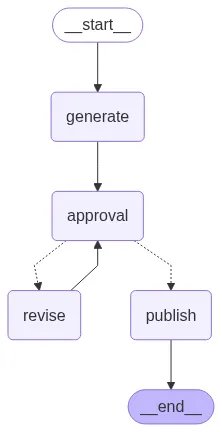
Within the HITL (human-in-the-loop) state of affairs, we’re inserting a Human step. After producing a tough draft, the agent stops and asks an individual to approve or make adjustments to the draft. If the draft meets approval, the agent publishes the content material. If the draft isn’t authorised, the agent revises the draft based mostly on suggestions and circles again. This state of affairs affords a better diploma of accuracy and belief, since people can catch errors previous to finalizing. For instance, including a affirmation step shifts actions to scale back “unintended” actions and confirms that the agent didn’t misunderstand enter. The draw back to this, after all, is that it requires extra time and human effort.
Instance Implementation in LangGraph
Under is an instance utilizing LangGraph and GPT-4o-mini. We outline two workflows: one absolutely automated and one with a human approval step.
State of affairs 1: With out Human-in-the-Loop
So, within the first state of affairs, we’ll create an agent with a easy workflow. It should take the person’s enter, like which subject we need to create the content material for or on which subject we need to write an article. After getting the person’s enter, the agent will use gpt-4o-mini to generate the response.
from langgraph.graph import StateGraph, END

from typing import TypedDict

from openai import OpenAI

from dotenv import load_dotenv

import os

load_dotenv()

OPENAI_API_KEY = os.getenv("OPENAI_API_KEY")

# --- OpenAI consumer ---

consumer = OpenAI(api_key=OPENAI_API_KEY)  # Change together with your key

# --- State Definition ---

class ArticleState(TypedDict):

   draft: str

# --- Nodes ---

def generate_article(state: ArticleState):

   immediate = "Write knowledgeable but participating 150-word article about Agentic AI."

   response = consumer.chat.completions.create(

       mannequin="gpt-4o-mini",

       messages=[{"role": "user", "content": prompt}]

   )

   state["draft"] = response.selections[0].message.content material

   print(f"n[Agent] Generated Article:n{state['draft']}n")

   return state

def publish_article(state: ArticleState):

   print(f"[System] Publishing Article:n{state['draft']}n")

   return state

# --- Autonomous Workflow ---

def autonomous_workflow():

   print("n=== Autonomous Publishing ===")

   builder = StateGraph(ArticleState)

   builder.add_node("generate", generate_article)

   builder.add_node("publish", publish_article)

   builder.set_entry_point("generate")

   builder.add_edge("generate", "publish")

   builder.add_edge("publish", END)

   graph = builder.compile()

   # Save diagram

   with open("autonomous_workflow.png", "wb") as f:

       f.write(graph.get_graph().draw_mermaid_png())

   graph.invoke({"draft": ""})

if __name__ == "__main__":

   autonomous_workflow()
Code Implementation: This code units up a workflow with two nodes: generate_article and publish_article, linked sequentially. When run, it has the agent print its draft after which publish it instantly.
Agent Workflow Diagram
Agent Response
“””Agentic AI refers to superior synthetic intelligence methods that possess the flexibility to make autonomous selections based mostly on their surroundings and targets. Not like conventional AI, which depends closely on predefined algorithms and human enter, agentic AI can analyze advanced knowledge, study from experiences, and adapt its conduct accordingly. This know-how harnesses machine studying, pure language processing, and cognitive computing to carry out duties starting from managing provide chains to personalizing person experiences.
The potential functions of agentic AI are huge, reworking industries corresponding to healthcare, finance, and customer support. For example, in healthcare, agentic AI can analyze affected person knowledge to supply tailor-made remedy suggestions, resulting in improved outcomes. As companies more and more undertake these autonomous methods, moral concerns surrounding transparency, accountability, and job displacement develop into paramount. Embracing agentic AI affords alternatives to reinforce effectivity and innovation, however it additionally requires cautious contemplation of its societal influence. The way forward for AI isn't just about automation; it is about clever collaboration.
”””
State of affairs 2: With Human-in-the-Loop
On this state of affairs, first, we’ll create 2 instruments, revise_article_tool and publish_article_tool. The revise_article_tool will revise/change the article’s content material as per the person’s suggestions. As soon as the person is completed with the suggestions and glad with the agent response, simply by writing publish the 2nd instrument publish_article_tool, it’s going to get executed, and it’ll present the ultimate article content material.
from langgraph.graph import StateGraph, END

from typing import TypedDict, Literal

from openai import OpenAI

from dotenv import load_dotenv

import os

load_dotenv()

# --- OpenAI consumer ---

OPENAI_API_KEY = os.getenv("OPENAI_API_KEY")

consumer = OpenAI(api_key=OPENAI_API_KEY)

# --- State Definition ---

class ArticleState(TypedDict):

   draft: str

   authorised: bool

   suggestions: str

   selected_tool: str

# --- Instruments ---

def revise_article_tool(state: ArticleState):

   """Device to revise article based mostly on suggestions"""

   immediate = f"Revise the next article based mostly on this suggestions: '{state['feedback']}'nnArticle:n{state['draft']}"

   response = consumer.chat.completions.create(

       mannequin="gpt-4o-mini",

       messages=[{"role": "user", "content": prompt}]

   )

   revised_content = response.selections[0].message.content material

   print(f"n[Tool: Revise] Revised Article:n{revised_content}n")

   return revised_content

def publish_article_tool(state: ArticleState):

   """Device to publish the article"""

   print(f"[Tool: Publish] Publishing Article:n{state['draft']}n")

   print("Article efficiently printed!")

   return state['draft']

# --- Accessible Instruments Registry ---

AVAILABLE_TOOLS = {

   "revise": revise_article_tool,

   "publish": publish_article_tool

}

# --- Nodes ---

def generate_article(state: ArticleState):

   immediate = "Write knowledgeable but participating 150-word article about Agentic AI."

   response = consumer.chat.completions.create(

       mannequin="gpt-4o-mini",

       messages=[{"role": "user", "content": prompt}]

   )

   state["draft"] = response.selections[0].message.content material

   print(f"n[Agent] Generated Article:n{state['draft']}n")

   return state

def human_approval_and_tool_selection(state: ArticleState):

   """Human validates and selects which instrument to make use of"""

   print("Accessible actions:")

   print("1. Publish the article (sort 'publish')")

   print("2. Revise the article (sort 'revise')")

   print("3. Reject and supply suggestions (sort 'suggestions')")

   determination = enter("nWhat would you love to do? ").strip().decrease()

   if determination == "publish":

       state["approved"] = True

       state["selected_tool"] = "publish"

       print("Human validated: PUBLISH instrument chosen")

   elif determination == "revise":

       state["approved"] = False

       state["selected_tool"] = "revise"

       state["feedback"] = enter("Please present suggestions for revision: ").strip()

       print(f"Human validated: REVISE instrument chosen with suggestions")

   elif determination == "suggestions":

       state["approved"] = False

       state["selected_tool"] = "revise"

       state["feedback"] = enter("Please present suggestions for revision: ").strip()

       print(f"Human validated: REVISE instrument chosen with suggestions")

   else:

       print("Invalid enter. Defaulting to revision...")

       state["approved"] = False

       state["selected_tool"] = "revise"

       state["feedback"] = enter("Please present suggestions for revision: ").strip()

   return state

def execute_validated_tool(state: ArticleState):

   """Execute the human-validated instrument"""

   tool_name = state["selected_tool"]

   if tool_name in AVAILABLE_TOOLS:

       print(f"n Executing validated instrument: {tool_name.higher()}")

       tool_function = AVAILABLE_TOOLS[tool_name]

       if tool_name == "revise":

           # Replace the draft with revised content material

           state["draft"] = tool_function(state)

           # Reset approval standing for subsequent iteration

           state["approved"] = False

           state["selected_tool"] = ""

       elif tool_name == "publish":

           # Execute publish instrument

           tool_function(state)

           state["approved"] = True

   else:

       print(f"Error: Device '{tool_name}' not present in accessible instruments")

   return state

# --- Workflow Routing Logic ---

def route_after_tool_execution(state: ArticleState) -> Literal["approval", "end"]:

   """Route based mostly on whether or not the article was printed or wants extra approval"""

   if state["selected_tool"] == "publish":

       return "finish"

   else:

       return "approval"

# --- HITL Workflow ---

def hitl_workflow():

   print("n=== Human-in-the-Loop Publishing with Device Validation ===")

   builder = StateGraph(ArticleState)

   # Add nodes

   builder.add_node("generate", generate_article)

   builder.add_node("approval", human_approval_and_tool_selection)

   builder.add_node("execute_tool", execute_validated_tool)

   # Set entry level

   builder.set_entry_point("generate")

   # Add edges

   builder.add_edge("generate", "approval")

   builder.add_edge("approval", "execute_tool")

   # Add conditional edges after instrument execution

   builder.add_conditional_edges(

       "execute_tool",

       route_after_tool_execution,

       {"approval": "approval", "finish": END}

   )

   # Compile graph

   graph = builder.compile()

   # Save diagram

   attempt:

       with open("hitl_workflow_with_tools.png", "wb") as f:

           f.write(graph.get_graph().draw_mermaid_png())

       print("Workflow diagram saved as 'hitl_workflow_with_tools.png'")

   besides Exception as e:

       print(f"Couldn't save diagram: {e}")

   # Execute workflow

   initial_state = {

       "draft": "",

       "authorised": False,

       "suggestions": "",

       "selected_tool": ""

   }

   graph.invoke(initial_state)

if __name__ == "__main__":

   hitl_workflow()

"""Human Suggestions:

Preserve the dialogue large and easy in order that each tech and non-tech folks can perceive

"""
Agent Workflow Diagram
Agent Response
“””Understanding Agentic AI: The Way forward for Clever Help Agentic AI represents a groundbreaking development within the discipline of synthetic intelligence, characterised by its means to function independently whereas exhibiting goal-directed conduct. Not like conventional AI methods that require fixed human intervention, Agentic AI can analyze knowledge, make selections, and execute duties autonomously. This revolutionary know-how has the potential to remodel varied sectors, together with healthcare, finance, and customer support, by streamlining processes and enhancing effectivity. One of the vital notable options of Agentic AI is its adaptability; it learns from interactions and outcomes, repeatedly enhancing its efficiency. As extra companies undertake this know-how, the alternatives for personalised person experiences and superior predictive analytics develop considerably. Nonetheless, the rise of Agentic AI additionally raises necessary discussions about ethics, accountability, and safety. Hanging the precise stability between leveraging its capabilities and making certain accountable utilization will probably be essential as we navigate this new period of clever automation. Embracing Agentic AI may basically change our interactions with know-how, in the end enriching our each day lives and reshaping industries. Article efficiently printed!
”””
Observations
This demonstration mirrored widespread HITL outcomes. With human assessment, the ultimate article was clearer and extra correct, according to findings that HITL improves AI output high quality. Human suggestions eliminated errors and refined phrasing, confirming these advantages. In the meantime, every assessment cycle added latency and workload. The automated run completed almost immediately, whereas the HITL workflow paused twice for suggestions. In observe, this trade-off is predicted: machines present pace, however people present precision.
Conclusion
In conclusion, human suggestions may considerably enhance agentic AI output. It acts as a security internet for errors and may hold outputs aligned with human intent. On this article, we highlighted that even a easy assessment step improved textual content reliability. The choice to make use of HITL ought to in the end be based mostly on context: it’s best to use human assessment in necessary circumstances and let it go in routine conditions.
As using agentic AI will increase, the problem of when to make use of automated processes versus utilizing oversight of these processes turns into extra necessary. Rules and finest practices are more and more requiring some stage of human assessment in high-risk AI implementations. The general thought is to make use of automation for its effectivity, however nonetheless have human beings take possession of key selections taken as soon as a day! Versatile human checkpoints will assist us to make use of agentic AI we will safely and responsibly.
Learn extra: get into Agentic AI in 2025?
Continuously Requested Questions
A. HITL is a design the place people validate AI outputs at key factors. It ensures accuracy, security, and alignment with human values by including assessment steps earlier than last actions.
A. HITL is unsuitable for routine, high-volume, or time-critical duties the place human intervention slows efficiency, corresponding to reside alerts or real-time content material filtering.
A. Human suggestions reduces errors, ensures compliance with legal guidelines and ethics, and builds belief and accountability in AI decision-making.
A. With out HITL, AI acts autonomously with pace however dangers unchecked errors. With HITL, people assessment drafts, enhancing reliability however including effort and time.
A. Oversight ensures that AI actions stay protected, moral, and aligned with human intent, particularly in high-stakes functions the place errors have critical penalties.

Good day! I am Vipin, a passionate knowledge science and machine studying fanatic with a robust basis in knowledge evaluation, machine studying algorithms, and programming. I’ve hands-on expertise in constructing fashions, managing messy knowledge, and fixing real-world issues. My aim is to use data-driven insights to create sensible options that drive outcomes. I am desperate to contribute my expertise in a collaborative surroundings whereas persevering with to study and develop within the fields of Knowledge Science, Machine Studying, and NLP.
Login to proceed studying and luxuriate in expert-curated content material.